
Why I bought a typewriter in 2024 and how it changed my writing
In times when everything is multi-functional, why would you choose to use a machine that only does one task?

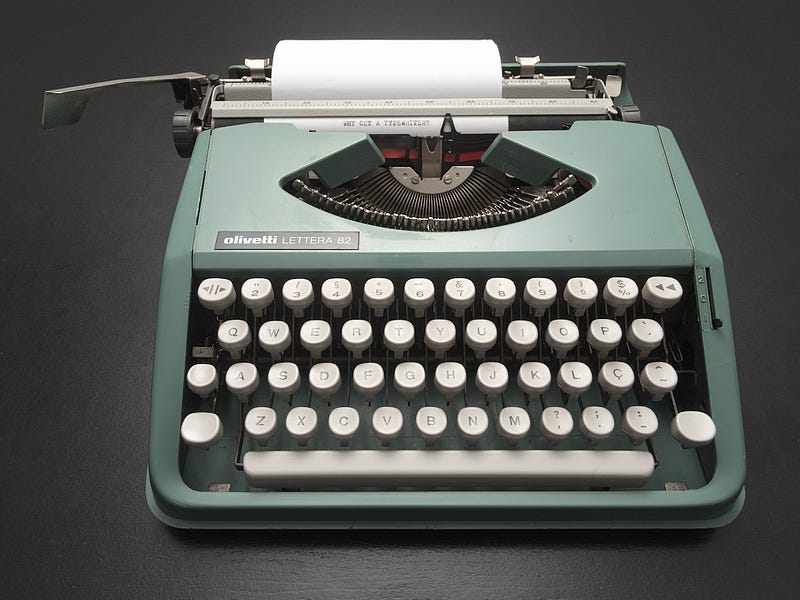
For a long time, typewriters were almost mythological creatures to me. I always had a romantic view of these noisy machines with so many moving parts. In my eyes, they were connected to a more poetic era of writing, one in which SEO optimization wasn’t yet a thing.
But in times when everything and everyone has to be multi-functional, time is money, and every action is a screen touch away, why would I deliberately choose to use a machine that only does a single task and would technically slow me down?
Well, that’s exactly the reason. At the beginning of 2024 my short story The Hanging Head got published by the DarkWinter literary magazine. Finally having a story published gave me the incentive I needed. I would keep trying my chances at writing fiction. It also made want to slow down and connect more with my writing process. For me, that included getting a typewriter.
You must be wondering, what has my poor laptop done to offend me so much? Or why can’t I simply stick with good ol’ pen and paper?
Well, when it comes to writing, it’s all about capturing ideas. The instruments you choose to do it will be very particular to you as a person. Like pretty much anything in life, what works for one doesn’t work for all.
To create a painting, some people use oil painting, others watercolor or acrylics. The goal may be the same, but the way to achieve the result changes from person to person. The same goes with writing.
In my case, the many functions of the computer are a constant temptation to my easily distracted mind. I do use a distraction free word processor, but still… my brain is so conditioned to do different tasks using the computer that it’s hard to switch modes and get into a zen writing state.
When it comes to longhand, the problem is that I think too fast, write too slowly, and my handwriting is a mystery even to myself.
So a machine dedicated solely to the craft of writing, and free of distractions, sounded like the perfect tool to capture my thoughts. I’ve used the typewriter, an Olivetti Lettera 82, for almost four months now, and it became a welcome companion on my writing adventures.
And since I started using it, I noticed some improvements in my writing process. If you’re thinking about getting yourself a typewriter too, here what to expect:
1. More focus
A while ago, I read that Neil Gaiman has a routine to avoid getting stuck on writing. When he sits to do his work, he allows himself to either write or do absolutely nothing. And the trick, he suggests, is that eventually doing some writing will be more interesting to the brain than doing nothing.
And I absolutely agree with him. Removing distractions makes all the difference in writing. And working with a typewriter reduces a lot of the distractions.
When I sit to work on the typewriter, I have no access to the internet, which means no internet browser, no checking emails or the news, or doing other task from my to-do list. There’s no little clock at the corner of the screen, no blinking cursor, no spellchecker, no “battery level is low” messages poping up. It’s just me and the page. The only thing I can do is write.
Instead of being bored staring endlessly at the white walls, my brain prefers to do something. And then the writing starts.
Like I said before, a distraction free word processor will probably take you half way there. But still, there’s a chance that you’ll give into temptation. After all, you still are using a computer and can click away at any time. The typewriter on the other hand physically removes the distractions from your hands.
2. Less fear
I think every writer — if you don’t, you’re very lucky — has the nagging fear of staring at a blank screen and not know what to put down to fill the space. It gets better the more you practice the craft, but it never truly goes away.
It is so hard sometimes to find the right words to express what you want to say! But obsessing about making something perfect held me back from writing anything for a long time.
I can’t delete what I write with the typewriter. Once I press the keys, the words are on the paper forever, and I have to deal with it. In some ways, that made me less scared of putting words down on the paper as they came. If I don’t like something I wrote, I will have to fix later on a second draft. Move on to the next sentence!

3. More fun
One of the pros of writing on a typewriter is the sensorial experience. The keys have weight, and when you press them down, pieces move, and they produce sound. When you get to the end of a line, the bell rings (Pling!). Time to push the return lever and go to the next line, the machine tells you.
You also print the letters on the paper as you type and once you're done, you can hold the leaf in your hands. And your pages will have a subtle smell of ink.
If you’re like me, these little sensorial stimuli will prevent you from wandering away from the page, and away from your story. You’ll stay more engaged and connected with what you’re writing.
4. Less productivity pressure
I wouldn’t say that my productivity magically increased by using a typewriter, but I do feel a lot more connected to my writing and that has helped me create more.
I’m more focused, less stuck, and enjoying writing more. Writing became more of a fun process rather than a stressful task, so my output and my word count slowly increased.
I’m not the second coming of Stephen King — far from it — but for a chronic perfectionist like me, every sentence is progress. Which leads me to the next point.
5. Word count feels less relevant
Since I can’t delete what I type when using the typewriter, the whole creative process is a little different.
Sometimes I will write two pages, but they contain more than pure writing. Sometimes I’ll rephrase a sentence underneath the first one, or leave a note to myself between two random paragraphs. It can look messy.
The point is, when I sit back to rewrite it, I’ll distill everything into only a couple of paragraphs. It may not be a lot, but more often than not it will be a couple of good paragraphs.
Somehow, as you fill the page with ideas, the word count will feel less and less relevant. The import part is that the story is growing, is moving somehow. Slowly but surely.
6. Slow pace, better words and grammar
English is my second language, and I tend to have problems spelling certain words, but I write pretty much all my stories in English. To my surprise the typewriter helped me a little in this area.
When using the typewriter I can’t type super fast, and again, I can’t delete anything, so I tend to think a little more before putting words down. That not only helped me write better sentences, but I also notice that my spelling is improving.
Conclusion
The typewriter became an import tool in the process of connecting with my writing at a deeper level. I’m very excited about the new stories I’m currently working on, and enthusiastic about working on them.
I think the lesson is that small changes can improve your writing significantly. Musicians and artists have dedicated instruments and tools to practice their art, and I believe it shouldn’t be different for writers.
It is so important to find a routine and a tool that helps you stay free of distractions and focus on the craft. For me that tool is the typewriter, how about you?
It's so important to find a balance in the use of technology, and a typewriter is a perfect way to do that with writing. It's great that you bought this typewriter and I like hearing you type on it too.